This guide is written in two parts. English first, Korean below. 이 글은 두 파트로 되어 있습니다. 영문이 먼저, 한국어가 아래에 있습니다.
PART 1 — ENGLISH
The terminal asks whether you want to pay in Korean won or in your own currency. Your currency looks helpful — you can see exactly what it costs without doing math.
Choose it and you just paid a markup of 3–7%, sometimes more. Every time.
This is called dynamic currency conversion, and it is the single most expensive habit a visitor can pick up in Korea. It is also the easiest to fix: always choose won.
1. The rule: always pay in Korean won
When a card terminal or an ATM offers you a choice of currency, pick KRW. Not dollars, not euros, not yen — won.
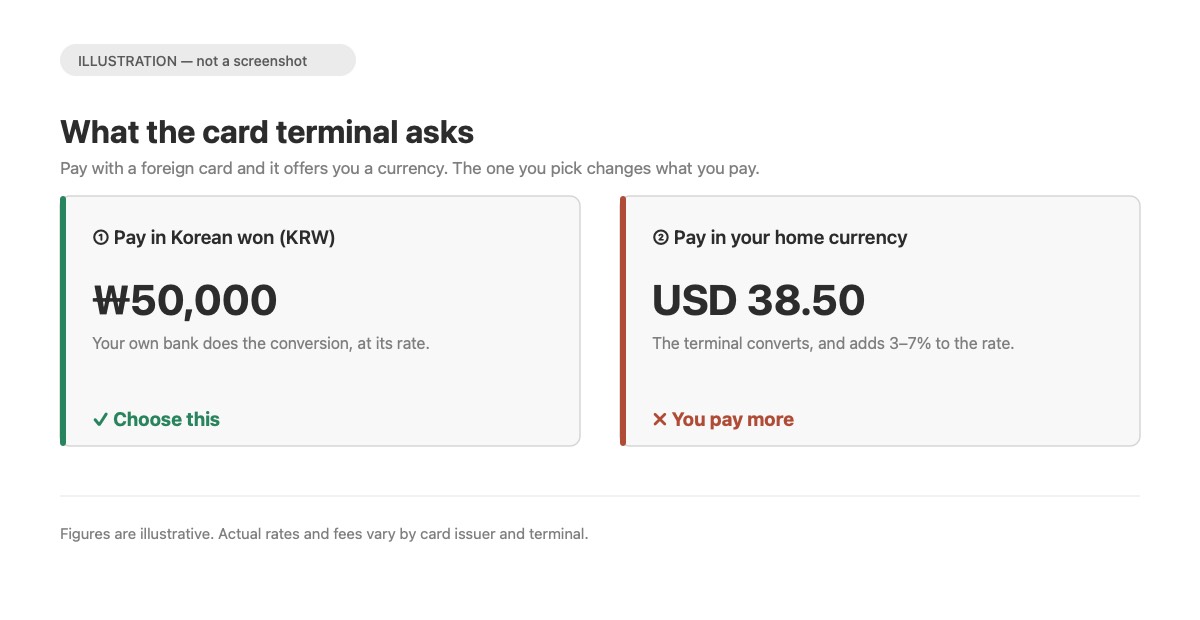
Choosing your home currency hands the exchange rate to the merchant’s payment processor instead of your card network. Studies of dynamic currency conversion find markups of 3–7% above the interbank rate, sometimes 12% or more (Beancount). Investigations have found that in every case examined, the customer paid more — between 2.6% and 12% more.
Your own bank will charge a foreign transaction fee either way, typically 1–3%. That fee is unavoidable. The DCC markup stacks on top of it and is entirely avoidable.
On a ₩300,000 shopping day, choosing wrong costs roughly ₩9,000–21,000. On a two-week trip it adds up to a nice dinner you did not get to eat.
2. Why the offer looks so appealing
The screen shows your home currency, which feels like a courtesy. Sometimes staff will helpfully press the button for you, assuming you would prefer to see familiar numbers.
They are not trying to cheat you. The commission goes to the payment processor, and merchants and ATM operators receive a cut. It is a business model built on the fact that “pay in your own currency” sounds like a service rather than a fee.
If you are ever unsure, say “Korean won, please.” Staff hear it constantly and will not find it strange.
3. Watch for it in three places
- Card terminals in shops — the most common. The prompt appears before you approve
- ATMs — the same choice appears when withdrawing cash, and the markup is identical
- Online checkouts — Korean sites sometimes default to your currency based on your card
If the receipt shows a total in your home currency, DCC was applied. Some banks let you dispute it; more practically, watch for it next time.
4. Where your card will not work at all
Avoiding DCC assumes your card works. In Korea, sometimes it will not.
Usually fine Department stores, hotels, chain restaurants and cafes, convenience stores (GS25, CU, 7-Eleven), major tourist attractions.
Often a problem Small local shops, traditional markets, street food, unmanned kiosks, and — this catches people out — most Korean delivery apps, which generally require a Korean card or bank account.
Transit is its own case. Foreign cards are not generally usable to tap directly on subway gates; you need a transit card such as T-money. Seoul has been rolling out kiosks that accept foreign cards for topping up, and broader card compatibility is planned, but do not arrive assuming your Visa will open the gate.
5. The local workaround you cannot use
Here is why the cash advice below is firmer than it looks.
When a Korean customer meets a shop that does not take cards, they rarely reach for cash. They send a bank transfer — account number, phone, done in seconds. It is so routine that many Koreans carry no cash at all, and small merchants are comfortable being paid this way.
That exit is closed to you. A bank transfer needs a Korean bank account, and a Korean bank account needs an Alien Registration Card — issued to people staying 91 days or more, and taking two to four weeks to arrive after you apply. A tourist stamp does not qualify.
There are edges to this. A few banks, Hana and Shinhan among them, will sometimes open a basic account on a passport and valid visa. But branches refuse it routinely, internet banking and check cards are often withheld, and none of it is something to plan a trip around.
So the chain that saves a local — card declined, transfer instead — has no second link for you. What is left is cash.
The partial bridge is a prepaid card aimed at foreign visitors, such as WOWPASS, which you load with cash and spend like a card. It does not open a bank account, but it covers some of the gap. See transit and prepaid cards.
6. So carry some cash
Not much, but some. Common guidance is ₩50,000–100,000 for general sightseeing, and ₩150,000–200,000 if you plan to spend time in traditional markets or eating street food.
When withdrawing at an ATM, the same rule applies: choose won, not your home currency.
7. Quick checklist
- At every terminal: choose KRW, never your home currency
- Same at ATMs — the markup is the same
- If staff offer to “help” by selecting your currency, say “won, please”
- Check receipts — a total in your home currency means DCC was applied
- Carry ₩50,000–100,000 cash; more for markets and street food
- Bank transfer is what locals use instead of cash — and you cannot. An account needs an Alien Registration Card, so cash is your only fallback
- Do not count on a foreign card for delivery apps or subway gates
- Your bank’s foreign transaction fee (1–3%) is separate and unavoidable — DCC is the part you control
PART 2 — 한국어
단말기가 원화로 결제할지, 당신의 통화로 결제할지 묻습니다. 자국 통화 쪽이 친절해 보입니다. 계산하지 않아도 얼마인지 바로 보이니까요.
그걸 고르면 3~7%, 때로는 그 이상을 더 낸 것입니다. 매번요.
이것을 자국통화 결제(DCC)라고 합니다. 한국을 찾는 여행자가 들이기 쉬운 가장 비싼 습관이자, 고치기는 가장 쉬운 습관입니다. 항상 원화를 고르세요.
1. 규칙: 무조건 원화로
카드 단말기나 ATM이 통화를 고르라고 하면 KRW(원화) 를 선택하세요. 달러도, 유로도, 엔도 아닙니다.

자국 통화를 고르면 환율 결정권이 카드 네트워크가 아니라 가맹점 결제사로 넘어갑니다. DCC를 분석한 자료들은 은행 간 환율 대비 3~7%, 때로는 12% 이상의 마크업을 보고합니다(Beancount). 조사된 모든 사례에서 소비자가 더 냈고, 그 폭은 2.6%에서 12% 사이였습니다.
카드사의 해외 이용 수수료(보통 1~3%)는 어느 쪽을 고르든 붙습니다. 그건 피할 수 없습니다. DCC 마크업은 그 위에 얹히고, 이건 전적으로 피할 수 있습니다.
30만원어치 쇼핑한 날이라면 잘못 고른 대가가 대략 9,000~21,000원입니다. 2주 여행이면 못 먹은 저녁 한 끼 값이 됩니다.
2. 왜 그렇게 친절해 보이는가
화면에 익숙한 통화가 뜨니 배려처럼 느껴집니다. 직원이 친절하게 대신 눌러주기도 합니다. 낯선 숫자보다 익숙한 숫자를 보고 싶어 할 거라고 생각해서요.
속이려는 것이 아닙니다. 수수료는 결제사로 가고 가맹점과 ATM 운영사가 일부를 나눠 갖습니다. “자국 통화로 결제하세요”가 수수료가 아니라 서비스처럼 들린다는 점에 기대는 사업 모델입니다.
헷갈리면 “원화로 해주세요”라고 말하세요. 직원들이 늘 듣는 말이라 이상하게 여기지 않습니다.
3. 세 곳에서 나옵니다
- 매장 카드 단말기 — 가장 흔합니다. 승인 전에 선택 화면이 뜹니다
- ATM — 현금 인출할 때도 같은 선택이 나오고 마크업도 같습니다
- 온라인 결제 — 카드 정보를 보고 자국 통화를 기본값으로 잡는 경우가 있습니다
영수증 총액이 자국 통화로 찍혀 있으면 DCC가 적용된 것입니다. 카드사에 이의를 제기할 수 있는 경우도 있지만, 현실적으로는 다음번에 주의하는 편이 빠릅니다.
4. 카드가 아예 안 되는 곳
DCC를 피하는 것은 카드가 된다는 전제가 있어야 합니다. 한국에서는 안 될 때가 있습니다.
대체로 되는 곳 백화점, 호텔, 체인 음식점과 카페, 편의점(GS25·CU·세븐일레븐), 주요 관광지.
자주 막히는 곳 소규모 상점, 전통시장, 길거리 음식, 무인 키오스크. 그리고 의외로 걸리는 것이 한국 배달앱입니다. 대체로 한국 카드나 계좌가 필요합니다.
대중교통은 별개입니다. 해외 카드로 지하철 개찰구를 직접 통과하기는 일반적으로 어렵고, T-money 같은 교통카드가 필요합니다. 서울이 해외 카드로 충전할 수 있는 키오스크를 확대하고 있고 호환 범위도 넓혀갈 계획이지만, 비자카드로 개찰구가 열릴 거라 기대하고 오지는 마세요.
5. 한국 사람들이 쓰는 우회로, 당신은 못 씁니다
아래 현금 조언이 생각보다 단호한 이유가 있습니다.
한국 손님은 카드가 안 되는 가게를 만나도 현금을 꺼내지 않습니다. 계좌이체를 합니다. 계좌번호나 전화번호만 있으면 몇 초면 끝납니다. 워낙 일상이라 현금을 아예 안 들고 다니는 사람이 많고, 소규모 상인들도 이 방식에 익숙합니다.
그 출구가 당신에게는 닫혀 있습니다. 계좌이체를 하려면 한국 은행 계좌가 있어야 하고, 계좌를 열려면 외국인등록증이 필요합니다. 91일 이상 체류자에게 발급되며 신청 후 2~4주가 걸립니다. 관광 입국으로는 해당되지 않습니다.
예외의 여지는 있습니다. 하나·신한 등 일부 은행이 여권과 유효한 비자만으로 기본 계좌를 열어주기도 합니다. 다만 지점에서 거절되는 경우가 흔하고 인터넷뱅킹과 체크카드가 제한되기도 해서, 여행 계획의 전제로 삼을 만한 것은 아닙니다.
그러니 현지인을 구해주는 흐름 — 카드 안 됨, 그럼 이체 — 에는 당신 몫의 두 번째 고리가 없습니다. 남는 건 현금입니다.
부분적인 다리는 외국인용 선불카드입니다. 와우패스처럼 현금을 충전해 카드처럼 쓰는 방식이고, 계좌를 열어주지는 않지만 빈틈의 일부를 메웁니다. 교통카드 4종 비교를 참고하세요.
6. 그래서 현금을 조금은 챙기세요
많이는 아니고 조금요. 일반 관광이라면 5만~10만원, 전통시장이나 길거리 음식에 시간을 쓸 계획이라면 15만~20만원이 흔히 권장됩니다.
ATM에서 인출할 때도 같은 규칙입니다. 원화를 고르세요.
7. 체크리스트
- 모든 단말기에서 KRW(원화) 선택. 자국 통화 금지
- ATM도 동일 — 마크업이 같습니다
- 직원이 자국 통화를 눌러주려 하면 “원화로 해주세요”
- 영수증 확인 — 총액이 자국 통화면 DCC가 붙은 것
- 현금 5만~10만원, 시장·길거리 음식 계획이 있으면 더
- 현지인은 현금 대신 계좌이체를 씁니다. 당신은 못 씁니다. 계좌 개설에 외국인등록증이 필요하므로 남는 퇴로는 현금뿐입니다
- 배달앱과 지하철 개찰구는 해외 카드를 믿지 마세요
- 카드사 해외 수수료(1~3%)는 별개이고 피할 수 없습니다. DCC가 당신이 통제할 수 있는 부분입니다
함께 읽으면 좋은 글
- 한국 택스리펀드 2026: 최소 금액은 3만원이 아니라 1만 5천원 — 카드로 낸 부가세 돌려받기
- 버스에서 내릴 때 카드를 대지 않으면 — 교통카드 쪽 함정
- 홍대입구역 올리브영 4곳 이용안내