This guide is written in two parts. English first, Korean below. 이 글은 두 파트로 되어 있습니다. 영문이 먼저, 한국어가 아래에 있습니다.
PART 1 — ENGLISH
There is no shortage of “15 Korean etiquette rules” articles. The trouble is that they mix things you will encounter on your first afternoon with things you will never encounter at all.
You will not be handing anyone a business card. You will not be pouring soju for a senior colleague. You almost certainly will not be writing anyone’s name in red ink.
You will be trying to get a server’s attention, standing in a subway doorway, and wondering whether to tip.
So this is sorted by how often it will actually come up.
1. Things you will hit on day one
Ordering — look at the table first
Almost every guide tells you to press the call bell. That was the standard, and it is now one of four systems you might meet — and no longer the most common.
Check your table when you sit down. It tells you which one applies.
| On the table | What to do |
|---|---|
| A tablet | Order on it yourself |
| A QR code | Scan it; the menu opens in your phone’s browser |
| A small button | Press it — staff come over |
| Nothing | Staff will come to you, or say “저기요” (jeo-gi-yo) |
Table tablets are now widespread, especially in chains and busier restaurants. Many have a language button. Where they do, this is the easiest of the four for a visitor — you order without a word of Korean and without flagging anyone down.
One thing worth knowing: a QR menu opens in your ordinary browser, so your phone can translate the page. A tablet is an app and usually cannot be translated that way. If the tablet has no English and there is also a QR code, the QR is your better route.
What to unlearn is waiting to be noticed. Staff do not circle the room looking for eye contact. Whichever system the table uses, the first move is yours.
Do not tip
The price on the menu is what you pay. Restaurants, taxis, hotels — no tipping.
This is not a case of “tipping is optional.” Leaving money can create confusion, and staff may chase you down to return it. If you want to be polite, just say thank you.
(For what actually happens at the payment terminal — including the currency question that costs 3–7% — see paying by card in Korea.)
The subway is quiet
Phone calls, speakerphone, music without headphones — all read as inconsiderate. Carriages are noticeably quieter than in most cities and the contrast is what makes it stand out.
Your takeaway coffee can get you refused on a bus
This one has actual teeth, and almost no English guide mentions it.
On the subway the rule depends on where you are standing, and guides tend to flatten this into one sentence.
Inside the station, eating is normal. Concourses and transfer passages have snack counters and small restaurants, and people eat at them. The system sells you the food; nobody minds you eating it there. Benches before the gates are fair game too.
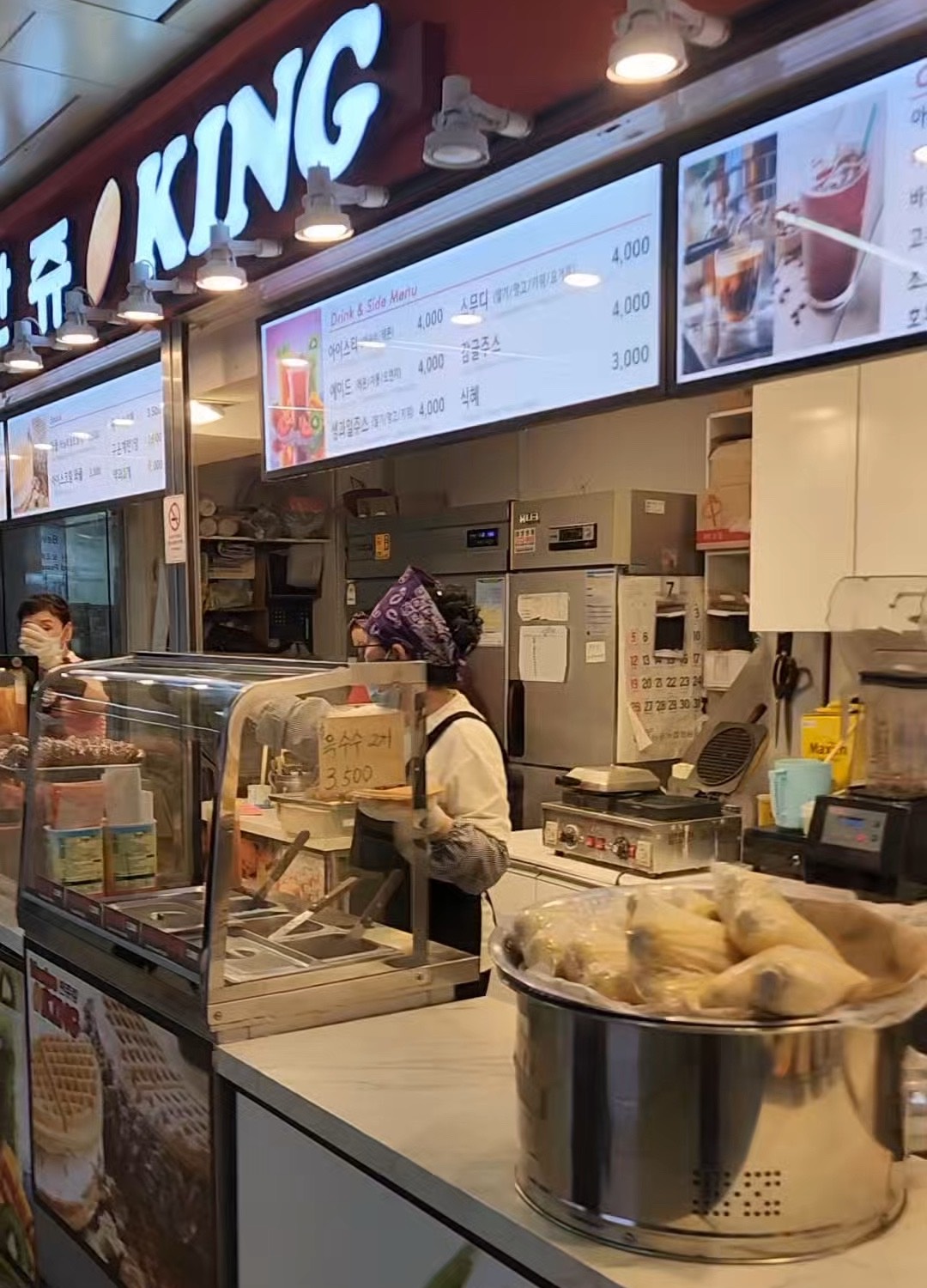
This is not a couple of vending machines. Stations carry chain coffee and doughnut outlets, and a few have burger places inside the gates. The small stalls selling delimanjoo, the little custard-filled corn cakes, are near-universal.
Most of these sit outside the ticket gates, in the concourse, so the safe default is: buy before you tap in.
Busier stations break that pattern. Some have outlets partway along the passages to the platforms, inside the paid area. Hongik Univ. Station is one of them. So it is worth a glance once you are through the gates rather than assuming you have missed your chance.
You can carry it through the gates and eat it on a platform bench. That is accepted — mildly conspicuous, perhaps, but nobody will stop you or say anything. There are three levels here, and only the last one is a real line:
| Where | How it reads |
|---|---|
| Outside the gates | Completely normal |
| Platform bench, inside the gates | Fine. You may feel slightly watched |
| On the train | Not done |
What actually decides the middle row is not a rule but how many people are around. A quiet platform, few others waiting, and you genuinely hungry — nobody minds, and Koreans treat that case as obviously fine. A packed platform at rush hour is a different situation, and a carriage is a different situation in any condition.
Which is the same instinct that governs most of this page: read the room rather than the rulebook.
The practical version is shorter than all of that. If you are hungry, eat at the station. It is set up for exactly this — buy before the gates, sit down, finish it, then board. Between the chain outlets and the delimanjoo stalls you will find something at almost any station, and it is cheap. Trying to eat on the move is the version that goes wrong.
Inside the carriage is different. A sealed bottle or closed tumbler is the practical limit. Eating is essentially not done — not an enforced ban with a fine, simply something nobody does, which is exactly what makes doing it conspicuous.
This tightened after COVID and has not loosened since. If you remember older accounts of people eating gimbap on the train, that era is over.
On buses the rule is stronger than manners. Under a Seoul city ordinance, a driver can refuse to let you board if you are carrying food in an open disposable container (Seoul Metropolitan Government).
| Refused | Fine to carry |
|---|---|
| Takeaway coffee cup with a sip hole | Sealed plastic bottle |
| Tteokbokki or snacks in an open paper cup | Unopened can |
| Anything unwrapped or leaking | Closed tumbler or thermos |
| Chicken or pizza in a sealed box | |
| Groceries in a bag |
So the cup that was fine on the subway can stop you at the bus door. Finish it, or decant it into something with a lid, before you board.
Enforcement rests with the driver, so it varies — some wave you on. But being turned away is a real possibility, and arguing at the door with a queue behind you is not how you want to start the ride.
Do not sit in the priority seats
The clearly marked seats at the ends of each carriage are for elderly, pregnant and disabled passengers. They are often left empty even when the carriage is full. That is deliberate, not an oversight, and sitting there when you do not qualify is noticed.
Do not block the flow
Standing right in the doorway, stopping in a transfer corridor, pausing at the top of an escalator, hesitating at the ticket gate. None of these is a rule anyone will recite, but all of them create friction in a system built around moving quickly.
Step aside to check your phone.
2. Things that come up if you stay longer
Two hands
Giving or receiving something — money, a card, a drink, a document — with both hands, or one hand supported at the wrist by the other, reads as respectful. One hand is casual, and toward someone older or senior it reads as careless.
Worth adopting because it costs nothing and is noticed positively. Nobody will correct you for getting it wrong.
Pouring drinks
If you are drinking with Koreans: you pour for others, they pour for you. Pouring your own is the odd move. Hold the bottle with two hands when pouring for someone older.
This is real and comes up quickly in social settings — but only if you are drinking with locals rather than other travellers.
Shoes off
Homes, guesthouses, some traditional restaurants with raised floor seating, temple stays. If you see a step up and a shelf of shoes, that is the signal.
3. Things you will probably never encounter
Travel guides list these constantly. As a visitor on a short trip, most are not going to arise:
| Frequently listed | Why it likely won’t apply |
|---|---|
| Business card etiquette | You are not exchanging cards on a holiday |
| Writing names in red ink | You will not be writing anyone’s name |
| Bowing depth and duration | A nod is fine; nobody expects choreography |
| Age-based speech levels | Handled by whoever speaks to you in English |
| Elaborate drinking rituals | Only if you end up out with locals — and then someone will guide you |
| “Cover your shoulders” dress advice | Widely repeated, and out of date in the districts you will actually spend time in |
Mentioning these is not wrong — they are real parts of Korean social life. They are just not what your trip will consist of, and treating them as urgent crowds out the things that actually matter.
The rules are not the same everywhere
Most etiquette guides write about Korea as one place. It is not, and the gap between neighbourhoods is wider than the gap between countries in some of these lists.
In Hongdae, Hongik University’s district, the norms are about as loose as they get in Korea. It is a young, student and nightlife area, and visibly ignoring the conventions a guide warned you about draws no reaction at all. Dress is a clear example: advice to cover your shoulders circulates endlessly in English travel writing, and in a district like this it simply does not match what people around you are wearing.
The same behaviour reads differently in other settings. A temple, a traditional restaurant with older regulars, a rural town — these carry expectations Hongdae does not.
So the useful instinct is not a rulebook but a glance. Look at what people around you are doing and match it. That works in every district and saves you memorising which rules apply where.
4. The one that surprises people
Nobody expects you to know any of this.
Korea receives a lot of visitors, and staff in tourist areas deal with people who do not know the local norms every single day. Getting something wrong will not cause a scene.
More than that: a first mistake is almost always let go. Koreans are, as a rule, generous about this. Nobody is keeping score on a visitor who bows at the wrong moment, pours their own drink, or hands something over with one hand.
The line is not the rulebook. It is rudeness. Get a convention wrong and it passes without comment. Be dismissive of the person in front of you, take up space you have not been given, treat staff as scenery — that registers, and it would register anywhere. Almost everything short of that is absorbed without friction.
Which means the practical advice is to stop worrying about the list and start moving. Hesitating in a doorway while you try to remember a rule causes more friction than breaking the rule would have.
The subway and bus points are the ones worth internalising, because those affect other people or can actually stop you boarding. The rest is polish.
If you order the way your table is set up for, keep your voice down on the train, and skip the tip, you have covered most of it.
5. Quick list
- Check the table to see how you order — tablet, QR code, call bell, or nothing. Do not wait for eye contact
- No tipping, anywhere
- Keep quiet on the subway — no calls, no speakerphone
- Hungry? Eat at the station. Buy before the gates, sit down, finish it, then board — the carriage is sealed drinks only
- An open takeaway cup can get you refused on a bus — finish it or seal it first
- Leave the priority seats empty even when the carriage is full
- Do not block doorways and corridors — step aside
- Two hands when giving or receiving, especially to someone older
- Do not pour your own drink in company
- Shoes off where you see a step and a shoe shelf
- Business cards, red ink, bowing angles — not your trip
- A first mistake is almost always let go. The line is rudeness, not the rulebook
- Norms vary sharply by district. Hongdae is among the loosest; temples and traditional restaurants are not
- Match what people around you are doing. It beats memorising rules
PART 2 — 한국어
“한국 예절 15가지” 같은 글은 넘칩니다. 문제는 도착 첫날 마주칠 일과 평생 마주치지 않을 일이 섞여 있다는 점입니다.
여행자는 명함을 건넬 일이 없습니다. 상사에게 소주를 따를 일도 없습니다. 누군가의 이름을 빨간 펜으로 쓸 일은 거의 확실히 없습니다.
하지만 직원을 부르는 방법, 지하철 문 앞에 서 있는 것, 팁을 줘야 하나는 반드시 마주칩니다.
그래서 실제로 마주치는 빈도순으로 정리했습니다.
1. 첫날 바로 마주치는 것
주문 — 테이블부터 보세요
거의 모든 안내가 호출벨을 누르라고 합니다. 예전에는 그게 표준이었고, 지금은 마주칠 수 있는 네 가지 중 하나이며 더 이상 가장 흔한 방식도 아닙니다.
앉으면 테이블을 먼저 보세요. 어떤 방식인지 테이블이 알려줍니다.
| 테이블에 있는 것 | 할 일 |
|---|---|
| 태블릿 | 직접 주문합니다 |
| QR 코드 | 찍으면 휴대폰 브라우저에 메뉴가 열립니다 |
| 작은 버튼 | 누르면 직원이 옵니다 |
| 아무것도 없음 | 직원이 오거나, “저기요” 하고 부릅니다 |
요즘은 테이블 주문 태블릿이 널리 퍼졌습니다. 특히 체인점과 붐비는 식당이 그렇습니다. 언어 버튼이 있는 경우가 많고, 있다면 방문자에게는 네 가지 중 가장 편합니다. 한국어 한마디 없이, 누구를 부르지 않고 주문이 끝납니다.
알아둘 점 하나. QR 메뉴는 일반 브라우저에서 열리므로 휴대폰의 번역 기능이 그대로 먹힙니다. 태블릿은 앱이라 그 방식으로 번역되지 않는 경우가 많습니다. 태블릿에 영어가 없는데 QR 코드도 함께 있다면 QR 쪽이 낫습니다.
버려야 할 습관은 알아봐 주기를 기다리는 것입니다. 직원이 눈을 마주치려고 돌아다니지 않습니다. 어떤 방식이든 먼저 움직이는 쪽은 손님입니다.
팁은 주지 않습니다
메뉴에 적힌 가격이 내는 돈의 전부입니다. 식당, 택시, 호텔 모두 팁이 없습니다.
“선택 사항”이 아닙니다. 돈을 두고 가면 혼란을 만들고, 직원이 돌려주려고 쫓아 나오기도 합니다. 고마움을 표하고 싶다면 인사말이면 충분합니다.
(계산대에서 실제로 일어나는 일 — 3~7%를 가져가는 통화 선택 질문 — 은 한국에서 카드 결제할 때에 정리했습니다.)
지하철은 조용합니다
통화, 스피커폰, 이어폰 없이 음악 재생은 배려 없는 행동으로 읽힙니다. 객차가 다른 도시들보다 눈에 띄게 조용해서 그 대비가 더 두드러집니다.
테이크아웃 커피 때문에 버스를 못 탈 수 있습니다
이건 실제로 강제력이 있는데도 영문 안내에 거의 나오지 않습니다.
지하철은 어디에 있느냐에 따라 다릅니다. 안내서들이 이걸 한 문장으로 뭉개는 경향이 있습니다.
역사 안에서 먹는 것은 자연스럽습니다. 대합실과 환승 통로에는 간식 코너와 작은 식당이 있고, 사람들이 거기서 먹습니다. 역이 음식을 팔고 있고, 그 자리에서 먹는 걸 아무도 문제 삼지 않습니다. 개찰구 앞 벤치도 마찬가지입니다.
자판기 몇 대 얘기가 아닙니다. 역에는 커피·도넛 체인이 들어와 있고, 개찰구 안에 햄버거 가게가 있는 역도 더러 있습니다. 델리만쥬 매대는 거의 어느 역에나 있습니다.
다만 이런 가게들은 개찰구 밖에 있는 경우가 대부분입니다. 그래서 안전한 기본값은 하나입니다. 찍고 들어가기 전에 사세요.
붐비는 역은 이 패턴에서 벗어납니다. 승강장으로 가는 통로 중간, 즉 개찰구 안쪽에 가게가 있는 역들이 있습니다. 홍대입구역이 그런 곳입니다. 그러니 이미 들어왔다고 포기하지 말고 한 번 둘러보세요.
사서 개찰구 안으로 들고 들어와 승강장 벤치에서 먹어도 됩니다. 받아들여지는 행동입니다. 조금 눈치가 보일 수는 있지만 누가 막거나 뭐라 하지 않습니다. 단계가 셋 있고, 진짜 선은 마지막 하나뿐입니다.
| 어디 | 어떻게 읽히나 |
|---|---|
| 개찰구 밖 | 완전히 평범합니다 |
| 개찰구 안 승강장 벤치 | 괜찮습니다. 살짝 눈치가 보일 수는 있습니다 |
| 열차 안 | 하지 않습니다 |
가운데 칸을 실제로 가르는 건 규칙이 아니라 주변에 사람이 얼마나 있느냐입니다. 한산한 승강장에 기다리는 사람이 몇 없고 정말 배가 고픈 상황이라면 아무도 신경 쓰지 않습니다. 한국 사람들도 그 정도는 당연히 괜찮다고 여깁니다. 혼잡한 시간대의 승강장은 다른 상황이고, 열차 안은 붐비든 아니든 다른 상황입니다.
이 글 대부분을 관통하는 감각과 같습니다. 규칙집이 아니라 주변을 한 번 보는 것입니다.
실용적으로 정리하면 위의 모든 설명보다 짧습니다. 배고프면 역에서 드세요. 역이 그러라고 되어 있습니다. 개찰구 전에 사고, 앉아서, 다 먹고 타면 됩니다. 체인점과 델리만쥬 매대를 합치면 웬만한 역에는 뭐라도 있고 값도 쌉니다. 문제가 생기는 건 이동하면서 먹으려 할 때입니다.
열차 안은 다릅니다. 뚜껑이 닫힌 병이나 텀블러 정도가 현실적인 한계입니다. 먹는 행위는 사실상 하지 않습니다. 과태료가 있는 금지가 아니라 그냥 아무도 안 하는 일이고, 그래서 하면 눈에 띕니다.
코로나 이후로 더 굳어졌고 다시 풀리지 않았습니다. 열차에서 김밥을 먹었다는 옛날 이야기를 봤다면, 그 시절은 지났습니다.
버스는 예절이 아니라 규정입니다. 서울시 조례에 따라 개방된 일회용 용기에 담긴 음식물을 들고 있으면 기사가 승차를 거부할 수 있습니다(서울특별시).
| 거부될 수 있음 | 들고 탈 수 있음 |
|---|---|
| 구멍 뚫린 뚜껑의 테이크아웃 커피 | 뚜껑 닫힌 플라스틱 병 |
| 종이컵에 담긴 떡볶이·간식 | 따지 않은 캔 |
| 포장이 뜯겼거나 새는 것 | 밀폐 텀블러, 보온병 |
| 상자에 포장된 치킨·피자 | |
| 봉지에 담은 장 본 식재료 |
지하철에서는 괜찮던 컵이 버스 문 앞에서 발목을 잡을 수 있습니다. 타기 전에 다 마시거나, 뚜껑 있는 용기로 옮기세요.
판단은 기사에게 달려 있어 편차가 있습니다. 그냥 태워주는 경우도 있습니다. 다만 거부당할 가능성이 실재하고, 뒤에 줄이 선 상태로 문 앞에서 실랑이하는 걸로 이동을 시작하고 싶진 않을 겁니다.
노약자석에 앉지 마세요
각 객차 끝에 표시된 좌석은 노인·임산부·장애인을 위한 자리입니다. 객차가 꽉 차도 비어 있는 경우가 많습니다. 실수가 아니라 의도된 것이고, 해당하지 않는 사람이 앉으면 눈에 띕니다.
흐름을 막지 마세요
문 앞에 그대로 서 있기, 환승 통로에서 멈추기, 에스컬레이터 끝에서 서기, 개찰구 앞에서 머뭇거리기. 누구도 소리 내어 지적하지 않지만, 빠르게 움직이도록 만들어진 체계에서는 모두 마찰을 만듭니다.
휴대폰을 볼 일이 있으면 옆으로 비켜서세요.
2. 오래 머물면 마주치는 것
두 손
물건을 주고받을 때 — 돈, 카드, 술잔, 서류 — 두 손으로, 또는 한 손을 다른 손목에 받쳐서 건네면 예의로 읽힙니다. 한 손은 편한 사이의 방식이고, 손윗사람에게는 무성의하게 보입니다.
비용이 들지 않고 좋게 받아들여지니 익혀둘 만합니다. 틀렸다고 지적받을 일은 없습니다.
술 따르기
한국 사람들과 술을 마신다면 서로 따라줍니다. 자기 잔을 자기가 채우는 게 오히려 어색합니다. 손윗사람에게 따를 때는 병을 두 손으로 잡습니다.
실제로 금방 마주치는 상황이지만, 여행자끼리가 아니라 현지인과 마시는 경우에 한합니다.
신발 벗기
가정집, 게스트하우스, 좌식 좌석이 있는 일부 전통 식당, 템플스테이. 턱이 있고 신발장이 보이면 그게 신호입니다.
3. 아마 평생 마주치지 않을 것
여행 안내에 끊임없이 등장하지만, 짧게 다녀가는 방문자에게는 대부분 일어나지 않습니다.
| 자주 등장하는 것 | 왜 해당되지 않나 |
|---|---|
| 명함 예절 | 여행 중에 명함을 주고받지 않습니다 |
| 이름을 빨간 펜으로 쓰지 않기 | 누군가의 이름을 쓸 일이 없습니다 |
| 인사 각도와 시간 | 가볍게 목례면 충분합니다 |
| 나이에 따른 존댓말 | 영어로 말을 거는 쪽이 알아서 조절합니다 |
| 복잡한 음주 예법 | 현지인과 어울리게 되면 그때 누군가 알려줍니다 |
| “어깨를 가리라”는 복장 조언 | 널리 반복되지만, 정작 시간을 보낼 동네에서는 낡은 이야기입니다 |
이런 것들을 언급하는 게 틀린 건 아닙니다. 한국 사회에 실재하는 부분입니다. 다만 당신의 여행을 채우는 내용이 아니고, 이걸 급한 일처럼 다루면 정작 중요한 것이 묻힙니다.
기준은 동네마다 다릅니다
대부분의 예절 안내는 한국을 하나의 장소처럼 씁니다. 그렇지 않고, 동네 간 격차가 그 목록들에 실린 나라 간 격차보다 큰 경우도 있습니다.
홍대는 한국에서 기준이 가장 느슨한 축에 속합니다. 젊은 층과 학생, 밤 문화가 중심인 지역이라, 안내서가 경고한 관습을 눈에 띄게 무시해도 아무 반응이 없습니다. 복장이 분명한 예입니다. 영문 여행 글에서 “어깨를 가리라”는 조언이 끝없이 돌지만, 이런 동네에서는 주변 사람들의 옷차림과 아예 맞지 않습니다.
같은 행동이 다른 자리에서는 다르게 읽힙니다. 사찰, 나이 지긋한 단골이 있는 오래된 식당, 지방의 작은 도시 — 홍대에 없는 기대가 있는 곳들입니다.
그래서 필요한 건 규칙집이 아니라 한 번 둘러보는 습관입니다. 주변 사람들이 하는 대로 맞추면 됩니다. 어느 동네에서나 통하고, 어느 규칙이 어디에 적용되는지 외울 필요도 없어집니다.
4. 의외로 놀라는 지점
아무도 당신이 이걸 알 거라고 기대하지 않습니다.
한국에는 방문자가 많고, 관광지의 직원들은 현지 관습을 모르는 사람들을 매일 상대합니다. 뭔가 틀려도 소동이 벌어지지 않습니다.
그 이상입니다. 처음의 실수는 거의 다 그냥 넘어갑니다. 한국 사람들은 대체로 이런 데 관대합니다. 인사 타이밍이 어긋났다고, 자기 잔을 자기가 채웠다고, 한 손으로 건넸다고 점수를 매기는 사람은 없습니다.
선은 규칙집이 아니라 무례함입니다. 관습을 틀리는 건 별말 없이 지나갑니다. 앞사람을 무시하거나, 양보받지 않은 자리를 차지하거나, 직원을 배경처럼 대하는 건 다릅니다. 그건 어디서든 티가 납니다. 그 선만 넘지 않으면 나머지는 거의 다 무리 없이 받아들여집니다.
그러니 실질적인 조언은 이렇습니다. 목록을 걱정하지 말고 그냥 움직이세요. 규칙을 떠올리느라 문 앞에서 머뭇거리는 쪽이 규칙을 어기는 것보다 더 많은 마찰을 만듭니다.
익혀둘 값어치가 있는 건 지하철과 버스 관련입니다. 주변 사람에게 영향을 주거나 실제로 승차를 막을 수 있기 때문입니다. 나머지는 마무리 손질입니다.
테이블에 맞는 방식으로 주문하고, 지하철에서 목소리를 낮추고, 팁을 두지 않으면 대부분 해결됩니다.
5. 한눈에
- 주문 방식은 테이블을 보고 판단 — 태블릿·QR·호출벨·없음. 알아봐 주기를 기다리지 마세요
- 어디서도 팁 없음
- 지하철에서는 조용히 — 통화·스피커폰 금물
- 배고프면 역에서 드세요. 개찰구 전에 사서 앉아 먹고 타면 됩니다. 열차 안은 밀폐 음료만
- 개봉된 테이크아웃 컵은 버스 승차 거부 사유가 됩니다. 미리 마시거나 옮기세요
- 객차가 차도 노약자석은 비워두기
- 문 앞과 통로를 막지 않기 — 옆으로 비켜서기
- 주고받을 때 두 손, 특히 손윗사람에게
- 여럿이 마실 때 자기 잔은 자기가 채우지 않기
- 턱과 신발장이 보이면 신발 벗기
- 명함·빨간 펜·인사 각도 — 당신의 여행과 무관
- 처음의 실수는 거의 다 넘어갑니다. 선은 규칙이 아니라 무례함입니다
- 기준은 동네마다 크게 다릅니다. 홍대는 가장 느슨한 축, 사찰이나 오래된 식당은 아닙니다
- 주변 사람들이 하는 대로 맞추세요. 규칙을 외우는 것보다 낫습니다
함께 읽으면 좋은 글
- 버스에서 내릴 때 카드를 대지 않으면 — 대중교통에서 실제로 손해 보는 것
- 한국에서 식사 제한이 있다면 — 주문할 때 말해야 할 것
- 홍대입구역은 사실 역이 세 개 — 역 안에서 먹을 수 있는 곳들
- 한국에서 카드 결제할 때 — 계산대에서 벌어지는 일