This guide is written in two parts. English first, Korean below. 이 글은 두 파트로 되어 있습니다. 영문이 먼저, 한국어가 아래에 있습니다.
PART 1 — ENGLISH
Search this and you get the same reassurance everywhere: yes, you can take luggage on the Seoul subway, there is no rule against it.
That is true and it is not the useful answer. There is no size limit. The difficulty is not the rule — it is the building.
Three things actually cost you on the subway: ticket gates, transfer distances, and rush hour. And there is one mode — the ordinary city bus — where a real size limit does apply. Here is what to do about each.
1. The gate is the first problem
Standard ticket gates in Seoul are narrow — sized for a person, not a person plus a hard case beside them. Pushing a large suitcase through the standard gate means lifting it, angling it, or holding up the queue behind you.
Use the wide gate instead. Every station has at least one, marked for wheelchairs, prams and mobility-impaired passengers. Luggage is a legitimate use — it is the same gate, it just opens wider.
It is usually at the end of the row of gates, often beside the staffed booth, and marked with a wheelchair symbol. You tap your card exactly the same way.
This one change removes most of the friction people describe at gates.
2. Distance, not stairs, is what tires you
Seoul stations are large, and transfers can be long. The one that catches travellers hardest is at Hongik Univ. Station, where the Line 2 ↔ Airport Railroad transfer is 355 metres — and that is the station most visitors arrive at from the airport.
| Station | Transfer | Distance |
|---|---|---|
| Hongik Univ. | Line 2 ↔ Gyeongui-Jungang | 414 m |
| Seoul Station | Line 1 ↔ AREX | 365 m |
| Hongik Univ. | Line 2 ↔ AREX | 355 m |
| Express Bus Terminal | Line 7 ↔ Line 9 | 314 m |
| Jongno 3-ga | Line 1 ↔ Line 5 | 312 m |
Check the number of transfers before you check the total journey time. A route that is five minutes faster but adds a transfer is usually slower with a suitcase, and considerably less pleasant.
Naver Map will show you the route options; picking the one with fewer changes is a decision the app will not make for you.
3. Lifts exist, but not everywhere you want them
Every station has at least one lift. The catch is that older stations may have only one, positioned at one specific exit — not necessarily the exit you want.
What this means in practice: you can almost always get from platform to street without stairs, but you may come out several hundred metres from where you intended.
Escalators are more widespread than lifts but often run in one direction only, and that direction changes by time of day.
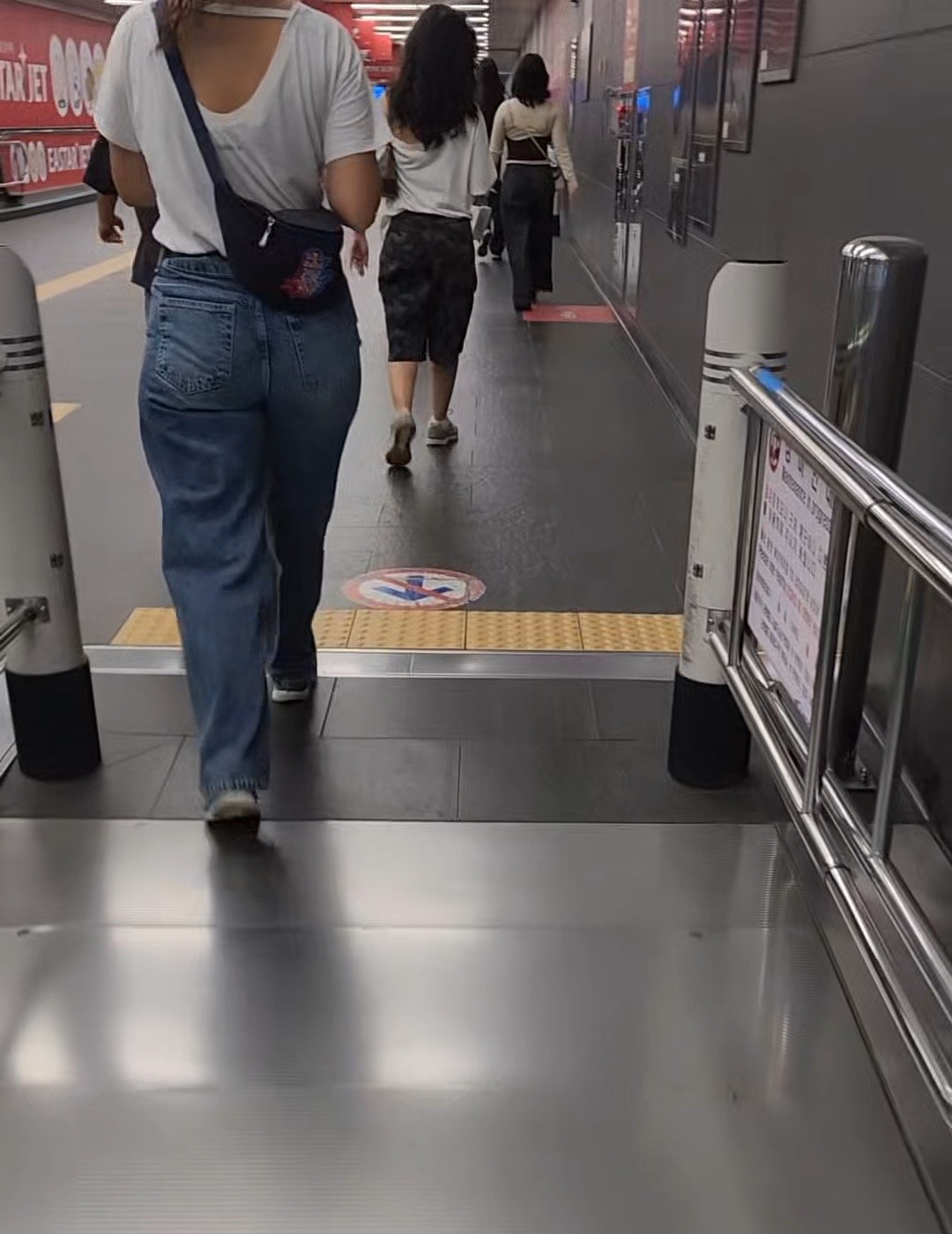
If stairs are genuinely not an option for you, plan the route in advance rather than improvising at the platform. Seoul Metro publishes station-by-station facility data — lifts, escalators, moving walkways, wheelchair lifts — through the Seoul Metropolitan Government’s accessibility pages.
4. Rush hour is a real constraint
There is no rule barring luggage at any hour. There is, however, a practical reality: on Line 2 between roughly 08:00–09:30 and 18:00–19:30, carriages fill to the point where a large suitcase is genuinely difficult to place and genuinely unwelcome.
This is not about etiquette lectures. It is that you will spend the journey holding a case upright in a crowd, and that is a bad twenty minutes.
Shift by an hour if you can. If you cannot, stand in the space beside the doors at the carriage ends rather than mid-carriage, and keep the case in front of you rather than beside you.
5. What is actually banned
One rule did change recently, and it is worth knowing because it catches people out.
Since July 1, 2026, Seoul Metro prohibits lithium batteries above 160Wh and personal mobility devices — e-scooters, e-bikes, electric skateboards, electric unicycles — from stations and trains (Seoul Metro, via Wikitree).
Ordinary luggage is not affected. Neither are phones, tablets or normal power banks, which sit well under the threshold. Wheelchairs and mobility aids are exempt.
If you were planning to bring a rented e-scooter into a station, that is the thing that changed.
6. The one mode that really does restrict you
Everything above is about the subway, where no size limit applies. City buses are different, and this catches people out.
Seoul’s city bus terms of carriage cap a passenger’s carry-on at under 20 kg and within 50 × 40 × 20 cm — roughly a 17–18 inch cabin bag. A checked-size suitcase is over the limit, and a driver may refuse to let you board. It has happened often enough to generate complaints in the Korean press.
Enforcement is at the driver’s discretion and varies with how full the bus is, so plenty of people board with larger cases without incident. But you cannot rely on it, and being turned away at the door with a bus queue behind you is a bad way to find out.
What this means in practice:
| Mode | Large suitcase |
|---|---|
| Subway | No size limit |
| Airport bus | Fine — it has a luggage hold underneath |
| City bus | Over 50 × 40 × 20 cm is above the stated limit |
| Taxi | Fine |
So the answer to “how am I supposed to get around with a suitcase” is: subway, airport bus, or taxi. The ordinary city bus is the one mode where a full-size case is a genuine problem, and it is also the one most guides never mention.
Airport buses are a different service with under-floor luggage compartments — see our airport transfer guide.
7. The alternative: do not carry it
The strongest move is often not to solve the luggage problem but to remove it.
Storage — subway lockers take app bookings and start around ₩2,200 for four hours. Staffed desks cost more but take oversized cases.
Delivery — the staffed T-Luggage desks will send your bag to another subway station or to Incheon Airport rather than holding it for pickup. On a departure day this can mean never touching your suitcase between the hotel and the airport.
Both are covered in our luggage storage guide.
8. Before you go
- There is no size limit on luggage in the Seoul subway
- Use the wide gate at the end of the gate row — it is the single biggest improvement
- Count transfers, not just minutes. Fewer changes beats a faster route
- The Hongik Univ. transfer runs 355–414 m depending on the line — plan for it if arriving from the airport
- Every station has a lift, but older ones have only one, at one exit
- Avoid Line 2 at 08:00–09:30 and 18:00–19:30 if you can
- Stand beside the doors at carriage ends, case in front of you
- Lithium batteries over 160Wh and e-scooters are banned since July 2026 — ordinary luggage is fine
- City buses cap carry-on at 50 × 40 × 20 cm — a checked-size case is over it. Subway, airport bus and taxi are fine
- Consider storing or shipping the bag instead of moving it
PART 2 — 한국어
검색하면 어디서나 같은 답이 나옵니다. 네, 서울 지하철에 짐 갖고 탈 수 있습니다, 금지 규정 없습니다.
맞는 말이지만 쓸모 있는 답은 아닙니다. 크기 제한은 없습니다. 힘든 건 규정이 아니라 건물입니다.
지하철에서 실제로 대가를 치르는 건 세 가지입니다. 개찰구, 환승 거리, 그리고 혼잡 시간. 그리고 진짜 크기 제한이 있는 수단이 하나 있습니다. 일반 시내버스입니다. 각각 어떻게 대응할지 정리했습니다.
1. 개찰구가 첫 관문입니다
서울의 일반 개찰구는 좁습니다. 사람 한 명 기준이지 사람 옆에 캐리어까지 감안한 폭이 아닙니다. 큰 캐리어를 일반 개찰구로 밀어 넣으려면 들어 올리거나 비스듬히 세우거나, 뒷사람을 세워두게 됩니다.
대신 넓은 개찰구를 쓰세요. 모든 역에 최소 하나는 있고, 휠체어·유아차·교통약자용으로 표시돼 있습니다. 짐을 든 경우도 정당한 사용입니다. 같은 개찰구이고 폭만 넓습니다.
보통 개찰구 줄 맨 끝, 역무실 옆에 있고 휠체어 표시가 붙어 있습니다. 카드 대는 방식은 똑같습니다.
이것 하나만 바꿔도 개찰구에서 겪는 불편은 대부분 사라집니다.
2. 지치게 만드는 건 계단이 아니라 거리입니다
서울의 역은 크고 환승이 깁니다. 여행자를 가장 세게 치는 곳이 홍대입구역인데, 2호선 ↔ 공항철도 환승이 355m입니다. 하필 공항에서 오는 방문자 대부분이 도착하는 역입니다.
| 역 | 환승 | 거리 |
|---|---|---|
| 홍대입구 | 2호선 ↔ 경의중앙선 | 414 m |
| 서울역 | 1호선 ↔ 공항철도 | 365 m |
| 홍대입구 | 2호선 ↔ 공항철도 | 355 m |
| 고속터미널 | 7호선 ↔ 9호선 | 314 m |
| 종로3가 | 1호선 ↔ 5호선 | 312 m |
총 소요시간보다 환승 횟수를 먼저 보세요. 5분 빠른데 환승이 하나 더 있는 경로는 캐리어가 있으면 대개 더 느리고 훨씬 피곤합니다.
네이버지도가 경로 후보를 보여주지만, 환승이 적은 쪽을 고르는 판단은 앱이 대신해 주지 않습니다.
3. 엘리베이터는 있지만 원하는 자리에 있진 않습니다
모든 역에 엘리베이터가 최소 하나는 있습니다. 문제는 오래된 역은 하나뿐이고, 특정 출구 쪽에 있다는 점입니다. 내가 나가려던 출구가 아닐 수 있습니다.
실제로는 이런 뜻입니다. 승강장에서 지상까지 계단 없이 갈 수는 거의 항상 있지만, 원하던 곳에서 수백 미터 떨어진 데로 나올 수 있습니다.
에스컬레이터는 엘리베이터보다 흔하지만 한 방향으로만 운행하는 경우가 많고, 그 방향이 시간대에 따라 바뀝니다.
계단이 정말 어려운 상황이라면 승강장에서 즉흥적으로 찾지 말고 미리 경로를 짜세요. 서울교통공사가 역별 시설 현황(엘리베이터·에스컬레이터·무빙워크·휠체어리프트)을 공개합니다(서울시 지하철 편의시설 안내).
4. 혼잡 시간은 실질적인 제약입니다
시간대별로 짐을 막는 규정은 없습니다. 다만 현실이 있습니다. 2호선 기준 대략 08:00~09:30, 18:00~19:30에는 객차가 큰 캐리어를 놓을 자리 자체가 없을 만큼 찹니다.
예절 설교를 하려는 게 아닙니다. 그 시간에 타면 인파 속에서 캐리어를 세워 붙들고 가야 하고, 그건 20분 내내 괴롭습니다.
한 시간만 비켜도 다릅니다. 어쩔 수 없다면 객차 중앙이 아니라 양 끝 출입문 옆 공간에 서고, 캐리어를 옆이 아니라 몸 앞에 두세요.
5. 실제로 금지된 것
최근에 규정이 하나 바뀌었고, 걸리는 사람이 있어 알아둘 만합니다.
2026년 7월 1일부터 서울교통공사는 160Wh를 넘는 리튬배터리와 개인형 이동장치 — 전동킥보드, 전기자전거, 전동보드, 전동휠 — 의 역사·열차 반입을 금지합니다(서울교통공사, 위키트리 보도).
일반 짐은 해당 없습니다. 휴대폰·태블릿·일반 보조배터리도 기준을 한참 밑돕니다. 휠체어와 보조기구는 예외입니다.
대여한 전동킥보드를 역에 들고 들어갈 생각이었다면, 바뀐 건 그겁니다.
6. 정말로 제한이 있는 수단 하나
여기까지는 지하철 이야기이고, 지하철에는 크기 제한이 없습니다. 시내버스는 다릅니다. 그리고 여기서 많이들 걸립니다.
서울 시내버스 운송약관은 승객 휴대품을 20kg 미만, 50 × 40 × 20cm 이내로 정하고 있습니다. 대략 17~18인치 기내용 캐리어 크기입니다. 위탁수하물 크기의 캐리어는 규정상 초과이고, 기사가 승차를 거부할 수 있습니다. 실제로 거부당했다는 민원이 언론에 보도될 만큼 일어납니다.
적용은 기사 재량이고 버스가 얼마나 붐비느냐에 따라 달라져서, 큰 캐리어로 별일 없이 타는 경우도 많습니다. 다만 기대할 수는 없고, 뒤에 줄이 선 상태로 문 앞에서 알게 되는 건 곤란합니다.
실제로는 이런 뜻입니다.
| 수단 | 대형 캐리어 |
|---|---|
| 지하철 | 크기 제한 없음 |
| 공항버스 | 문제없음 — 하부 짐칸이 있습니다 |
| 시내버스 | 50 × 40 × 20cm 초과는 규정 기준을 넘습니다 |
| 택시 | 문제없음 |
그러니 “캐리어 들고 어떻게 다니라는 건가”에 대한 답은 지하철·공항버스·택시입니다. 일반 시내버스가 대형 캐리어에 진짜 문제가 되는 유일한 수단이고, 하필 대부분의 안내가 언급하지 않는 부분입니다.
공항버스는 하부 짐칸이 있는 다른 서비스입니다. 공항 이동 안내를 참고하세요.
7. 대안은 아예 안 들고 다니는 것
가장 강력한 수는 짐 문제를 푸는 게 아니라 없애는 것입니다.
보관 — 지하철 물품보관함은 앱 예약이 되고 4시간 2,200원부터입니다. 유인 데스크는 더 비싸지만 대형 캐리어를 받습니다.
배송 — 유인 또타러기지 데스크는 짐을 보관했다 돌려주는 대신 다른 지하철역이나 인천공항으로 보내줍니다. 출국일이라면 숙소에서 공항까지 캐리어를 아예 안 만질 수도 있습니다.
둘 다 짐 보관 안내에 정리했습니다.
8. 타기 전에
- 서울 지하철에 짐 크기 제한은 없습니다
- 개찰구 줄 맨 끝의 넓은 개찰구를 쓰세요. 체감 개선이 가장 큽니다
- 소요시간보다 환승 횟수를 보세요. 환승이 적은 쪽이 낫습니다
- 홍대입구역 환승은 노선에 따라 355~414m — 공항에서 온다면 감안하세요
- 모든 역에 엘리베이터가 있지만, 오래된 역은 하나뿐이고 특정 출구 쪽입니다
- 가능하면 2호선 08:00~09:30, 18:00~19:30은 피하세요
- 객차 양 끝 출입문 옆에 서고 캐리어는 몸 앞에
- 160Wh 초과 리튬배터리와 전동킥보드는 2026년 7월부터 금지 — 일반 짐은 무관
- 시내버스는 휴대품이 50 × 40 × 20cm 이내입니다. 위탁수하물 크기는 초과입니다. 지하철·공항버스·택시는 괜찮습니다
- 옮기는 대신 맡기거나 부치는 것을 먼저 검토하세요
함께 읽으면 좋은 글
- 홍대 짐 보관 — 네 가지 선택지 — 맡기는 쪽을 고른다면
- 홍대입구역은 사실 역이 세 개 — 355m 환승의 정체
- 인천·김포공항에서 서울 시내로 — 짐이 가장 많은 날
- 버스에서 내릴 때 카드를 대지 않으면 — 대중교통에서 실제로 손해 보는 것
참고자료 / Sources
- 서울시 — 지하철 편의시설 안내 (영문)
- 위키트리 — 7월부터 서울 지하철 반입 금지 품목
- 또타러기지 공식
- 이즐 — 버스 승차거부 기준과 휴대품 규정
- 나무위키 — 홍대입구역 (환승 거리)
혼잡 시간대는 일반적으로 통용되는 범위이며 노선·구간에 따라 다릅니다. 반입 금지 규정과 편의시설 정보는 공식 자료 기준입니다.